We’re back for another update as we continue to track the top teams across college basketball and separate the wheat from the chaff. A quick aside before we dive in…we have to once again address Auburn, who continues to look weaker here than any other place you’d look, so many might have questions. Right now they are the clear 4th most trustworthy team, so not bad at all, but most college hoops fans would have them as their favorite to win it all. So why are they 4th and why am I comfortable with that? They haven’t defended consistently, and the main discovery of this entire exercise is being balanced is the key to March success. Interestingly, they have played the 3 teams ahead of them already this year, going just 1-2. They beat Houston (by 5) and lost to Duke and Florida. That’s a pretty good marker right there, and you can see in all 3 of those games they gave up well over 1 point per possession. They are obviously an elite offensive team, but it is clear what the weakness is and it is more of a weakness than those other 3 teams have. It will be interesting to see how they defend Alabama on Saturday night, as they are the 2nd best offensive team. A good performance defensively could see Auburn climb up into a better spot, but another performance like the one against Florida and people may stop questioning why they are just 4th here. Also important to note that in other year’s there might only be 1 other team in the conversation with Auburn, but this year offers up more dominant teams at the top than we’ve seen in several years, so this should not discredit how good Auburn is as much as it highlights how great Duke/Florida/Houston have been.
For those new here, a quick refresher – The goal of this entire exercise is simple, try and place the “best” teams in college basketball into Archetypal buckets, and assess their likelihood of going on a deep run in March based on where they fall. This will all be derived from years of Kenpom data (2005-2024) which I have compiled to create 8 unique archetypes that, in my opinion, will help all who take notice avoid backing a horse that falls in the first weekend, and instead, lead you to hitch your wagon to one that finds itself making a deep tourney run. What we’re not attempting to do is pick the team that comes out of nowhere and goes on a deep run, a la NC State last year.
So, we will focus on the top-30 in Kenpom as of each update. For context, entering the tournament just 8 of the 76 (10.5%) total Final 4 teams since 2005 have entered the tourney outside the top-30. Just with that we already can narrow down our focus and begin to analyze what characteristics of those teams we can identify as key indicators. On top of that we can track week over week movements and spot teams who are improving vs fading.
The 8 Archetypes are:
- Elite
- Great
- Solid
- Strong Enough
- Matadors
- Grinders
- Vanilla
- Wannabe’s
Below I will provide some context for each archetype and list the teams that fall in at the time of publishing. There will be a graphic for each category that shows the criteria and the percentage of teams who fell into that category since 2005 that made it to each round. For example, 83.9% of Elite teams have made it out of the first weekend into the Sweet 16. Juxtapose that with just 19.6% of Vanilla teams and you should catch on real quick to what we’re doing here.
This week’s update:

ELITE:

Here is where we find the cream of the crop in college basketball, as these are the teams who are top-10 in both offensive and defensive efficiency. These are exceptionally good teams, with only 1 such team over the last 2 seasons. However, we’ve already had Iowa St, Auburn and Duke land here, with both the Cyclones and Blue Devils still here this week, so it’s not looking like a year without an elite team. 84% of these teams survive the first weekend, with a whopping 42% getting to the Final 4, almost 20 points better than the next closest Archetype.
Houston and Duke remain the stalwarts in the Elite group, as they continue to play extremely efficient on both ends of the floor. However, we also have a new addition to this group in Florida, fresh off of their upset win @ Auburn they join these 2 at the top of the sport.

GREAT:

The next couple are going to be pretty obvious but we’re notching down a peg to teams who weren’t top-10 but do happen to be top-15 on both ends of the floor. It’s pretty consistent in terms of odds of getting out of the first weekend, but does drop off decently as you go to Elite 8 and beyond. Still, with only 31 teams to have entered the tourney as “Elite” since 2005 we may find the 2nd or 3rd options this year fall here. These aren’t always your top seeds either, with 2023 UConn being a perfect example as a 4 seed falling here and winning the whole thing.
Auburn has fallen again and we now have zero teams in the great category, so down to 3 teams in Elite/Great but all qualifying as Elite now as Florida jumps up, for now.
SOLID:

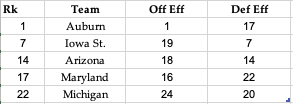
Following the trend here, down a peg to teams who were top-25 on both ends but outside of top-15. I will note the difference between top-20 and top-25 was negligible, with the top-20 teams much more resembling the top-25 numbers vs the top-15, so they’ve been combined.
Auburn drops to solid once again, as they’ve oscillated up and down the ranks from Elite all the way down to Solid. Defensively they are just not consistent enough to join that group, but they have a huge chance @ Alabama this weekend to improve on that and get a big win. The rest of this group are similar names, with Arizona and Maryland still of note as they are hot and improving.
STRONG ENOUGH:

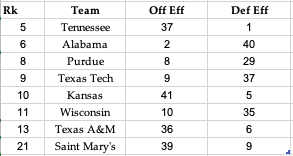
This is where we start getting a little unique and into the weeds, as we’ve had to find a bucket for those that fail to land in the top-25 on both ends but are elite on one end of the floor. Conversely they aren’t horrible on the other end, so they don’t drop down to our vulnerable categories. They’re just good enough on their weaker end of the floor that their elite abilities are able to carry them with some confidence out of the first weekend. I had to find the line of demarcation, where the weakness became tangible in the results. The teams ranking above 50 over and over again stood out with early exits, so that’s where it stuck after the numbers confirmed that the teams that live in this area perform much better than those in the “Matadors” or “Grinders” categories just by limiting that weakness. Obviously, the weakness is still indicating less reliability, with nearly half as many “Strong Enough” teams reaching the Elite 8 as “Elite” teams (35% vs 67%.).
MATADORS

Now we get into the teams we have to start worrying about which are the overly unbalanced teams. This group will be the teams that can put on a show offensively but who really struggle defensively. We’ve seen time and time again this type of team lose in the first round, including top seeded teams like Kentucky (’24), Iowa (’22), and Ohio St (’21) just to name a few recent examples. The data tells us if you’re gonna be bad on one end it’s better to be worse on D than O, but it still is a stark drop off from 62% (Solid) to the Sweet 16, to just shy of 37% here.
We’re down to just the Wildcats, who have fallen from grace after picking up massive wins earlier in the season. Teams like Baylor, Wisconsin, Purdue and Gonzaga have all found themselves here at some point but have made improvements defensively lately, but they’re certainly capable of finishing here if they slip up down the stretch.

GRINDERS:

Similar to the Matador group this group of teams is very unbalanced, just on the other end of the floor. We all know teams like this, that are forced to take you to the deep waters and test your resolve. Physicality, toughness and relentless pressure on D, but they just can’t seem to score the basketball on a consistent basis. These teams historically have really struggled in March, with nearly 3/4 of them flaming out the first weekend. Some recent examples include Iowa St (’23), LSU (’22), Kansas and Tennessee (’21) among many others.
The Johnnies remain our lone grinder, but UCLA is creeping.

WANNABE’S
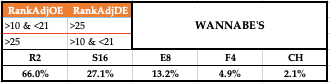
I classified these teams as wannabe’s because they are unbalanced, excelling on one end of the floor compared to the other but not at an elite level. They’re solid on one end and competent on the other, keeping them out of the Vanilla category thanks to their better than average ability on one end but still it is not enough to make up for their deficiency on the other.
VANILLA:
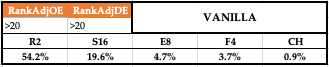
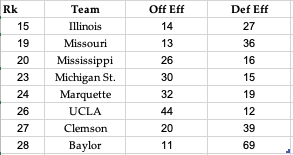
These are your purely average teams, who don’t truly excel on either end of the floor. They find ways to win and remain amongst the top-30 teams but without that true strength to lean on and without the overall elite ability they’re just kind of meh, and you see it in the numbers. With greater than 80% failing to make it out of the first weekend and nearly half checking out after just 1 game these are the last teams you want to trust come March. Some recent examples include Texas Tech (’24), Virginia/Duke/Indiana (’23) and Illinois/UConn (’22) who all failed to get out of the first weekend.
 5-STAR Bracketology