Most recent update HERE
What a week across college hoops, and welcome back to what will hopefully become your bubble respite over the next few weeks as we count down to Selection Sunday. The story of the season continued as the top teams in the country, for the most part, continued to dominate their way through conference play. There were a few notable bubble upsets though, with Indiana taking the cake as the story of the week as they racked up 2 big time Q1 wins over Purdue and UCLA to surge to the Last 4 in / First 4 Out discussion. Ultimately though, those stories of picking up big time wins seem few and far between this year, as teams like Virginia Tech, TCU, Wake Forest and many others continue to miss out on chances to knock off the big boys. What that is leading us to is widening our net to try and find more bubble teams in these smaller conferences, with a 3-bid WCC on the table and a 4th and 5th MWC team getting added to the Watch this week. While we are getting some fantastic showdowns with titans in the Big 12 and Big 10, the bubble increasingly looks like it’s going to be filled with mid-major teams piling up wins and holding on to a couple of top-50 wins. That may be enough this year given how teams like Ohio St, Miami, Oklahoma St and more continue to whiff on their chances in conference play. Maybe it will shift, but so far, the top is strong, and that ripple effect is making itself obvious as we break down these bubble resumés. No matter how it looks, we’ll still be here breaking it all down, so with that let’s get to it.
For those new here stick with me, as I explain more about what I’m doing, vets can skip ahead with the buttons below.
So, I’m going to assign teams to 4 groups – Locks, On the Right Track, Teetering and Outside Looking In. Any team left out is not even on the radar. To avoid any confusion, let’s quickly define what I’m looking at for each.
“Locks” – Basically, these are teams I don’t see a world they don’t get in. I must admit I’m a below average gambler, see last year, so I am going to be quite stingy when it comes to assigning locks, ya better have the resumé to lose almost every game left and still get in.
“On the Right Track” – This group will range from teams who are on the precipice of getting locked down to teams who lie in the 6-7 seed range, as they’re comfortably in the field but a string of losses could send them spiraling toward the true bubble danger zone.
“Teetering” – This is the group of teams that are truly on the bubble, where every win and loss can shift where they stand and how comfortable they feel. They could range from the 8-9 seeds who look solid but are by no means safe, to the teams you find on the first 4 or next 4 out lists.
“Outside Looking In” – These are the desperate teams, who are not close to in according to Bracket Matrix, but have enough opportunities to have a path to work themselves in.
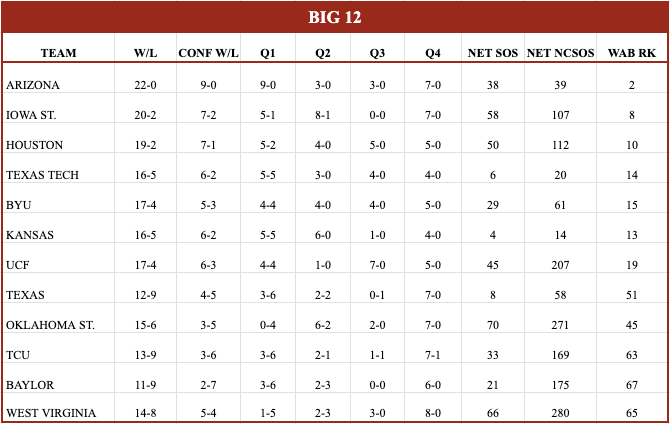
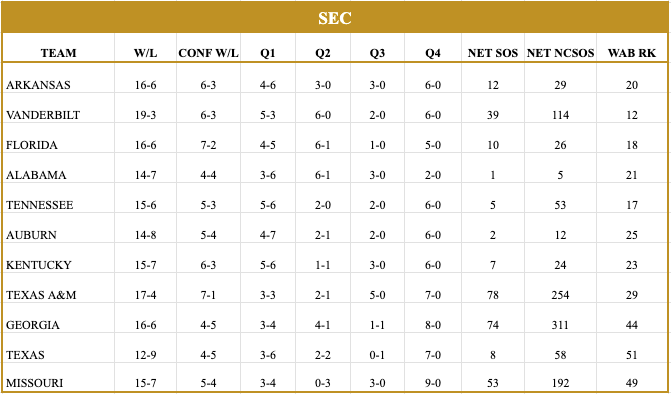
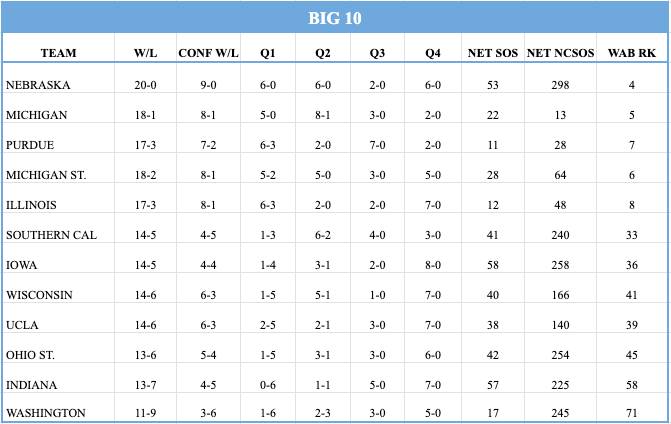
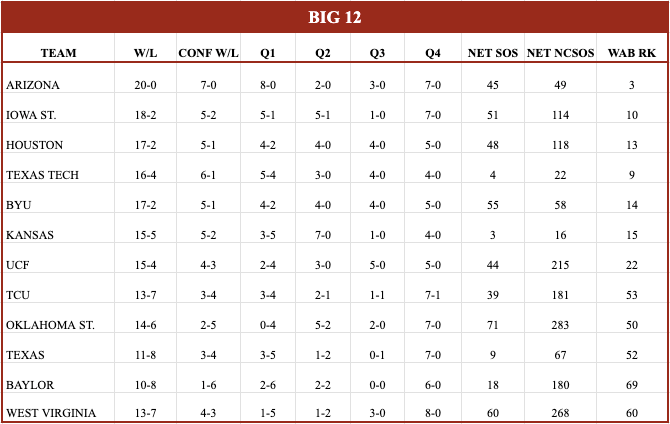
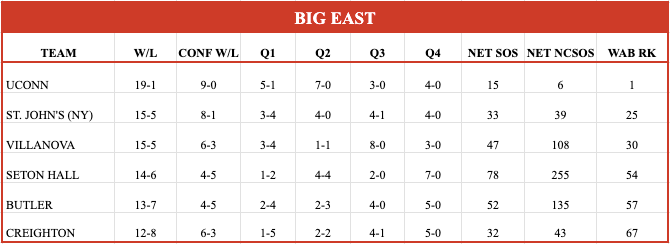
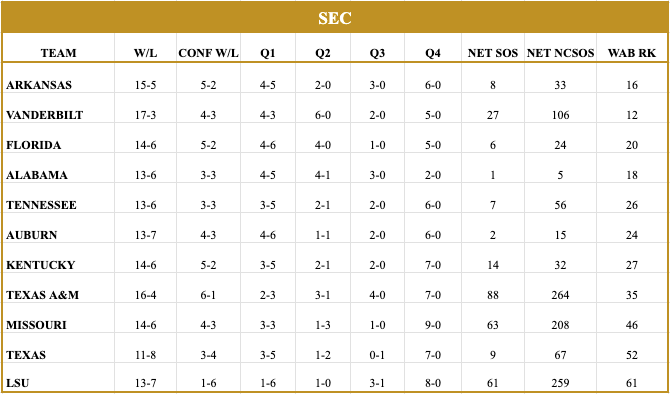
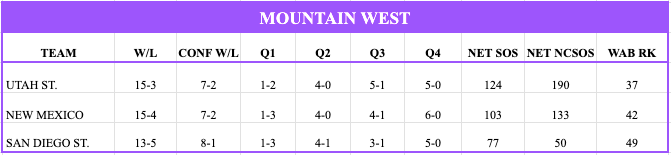
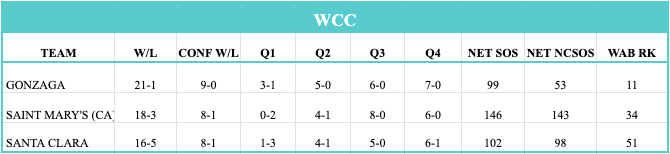
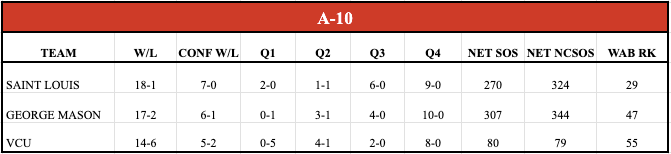
I have provided below the Quadrant system to help contextualize what I’m referring to when discussing wins. Each conference has a table with the team’s resumé to reference at the beginning, for your own comparison, including the locks. Also worth mentioning, any of these teams can get their way in by winning the Conference tourney, I’m assuming with all of these blurbs they will need an at-large bid. For a breakdown of the available bubble spots see below, as we have 62 teams on the Watch, but many of those will be missing out. So without further ado, let’s get it. All info as of 2/2. Check out my current bracket projection here.
| Quadrant 1 (Q1) | Quadrant 2 (Q2) | Quadrant 3 (Q3) | Quadrant 4 (Q4) |
| Home (1-30) | Home (31-75) | Home (76-160) | Home (161-364) |
| Neutral (1-50) | Neutral (51-100) | Neutral (101-200) | Neutral (201-364) |
| Away (1-75) | Away (76-135) | Away (136-240) | Away (241-364) |
Bubble Breakdown:
Total Bids: 68
1-bid conferences: 23
Locks: 10
Bids Left: 35
Bubble: 52
–ACC–

Locks:

On the Right Track:
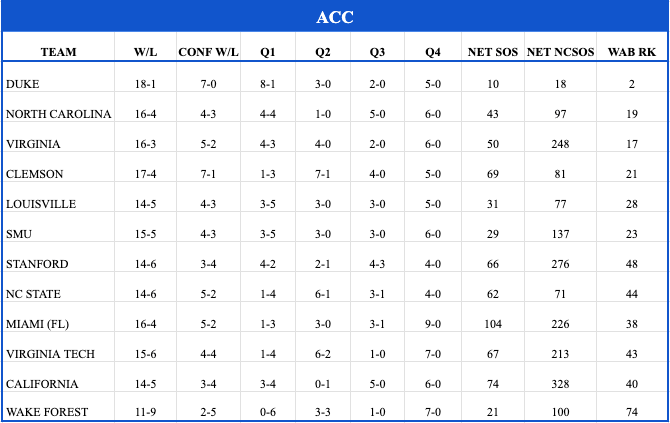
UNC (23 NET)

The Tar Heels played just once since we last met and they went on the road and stayed hot, taking care of GA Tech with ease. The story this entire season has been guard play, as we know they have one of the best front courts in the country with Veesar and Wilson. Trimble is steady now that he’s back from injury, but it’s been the play of Bogavac of late who has been a huge spark with 7 threes during this 3 game winning streak. Having a shooter to stretch the floor will be critical going forward, as the other 3 guards who have played have struggled to do so at times. This week is going to be a major test for the Heels though as they host rival Duke on Saturday after hosting Syracuse tonight. Gotta take care of business vs the Orange and then all eyes will be on Chapel Hill. I’m certainly not going to say this is a must win, but if they want to feel like a true contender nationally getting this one at home is the perfect way to make that statement. A 2-0 week will lead us to locking UNC I would think, but anything short of that will leave a trace of doubt going forward.
Virginia (18)

It was a tricky week for the Hoos as they looked to bounce back from a home loss to UNC. They traveled to Notre Dame and were fortunate to come away with a 2OT win over the Irish, then went to BC and came away with a close W over the bottom dwelling Eagles. Certainly not a week that will inspire much confidence, but from a resumé standpoint that’s 2 wins and more importantly they avoided adding a bad loss to the tally. I’m not sure if this is a bit of a regression to the mean after some hot play, but you it’s also hard to pick apart a team that is 18-3 and within that is an 8-3 record in Q1-2. They haven’t beaten anyone inside the top-20 aside from Louisville who was without Mikel Brown. However, they have 3 Q1(A) wins with Louisville, SMU and NC State on the road. Not sure many would realize that, but it’s one of the stronger resumé’s in the country, even though many probably have question marks about them after the last 3 games. We’re not going to see them tested for some time either, as they just get Pitt and Syracuse at home this week. 2 should be wins, so we’ll probably be close to locking next week if they handle their business. Will be one of the most interesting teams in the field if they maintain their winning ways.
Louisville (17)

I would call the last 7 days a bit of a roller-coaster for Louisville as they were feeling good with Mikel Brown back in the lineup and then absolutely got their doors blown in at Cameroon Indoor, losing by 31. That is a result that can alter seasons in a negative way, but credit to Pat Kelsey and co. as they bounced back and handled SMU at home on Saturday to steady the ship. Brown was really bad in the game @ Duke, resulting in his removal from the starting lineup vs SMU. Message received, as he came off the bench and scored 20 points in 29 minutes. One of those classic coaching moves where you send a message to a kid, and it appeared from his play that Brown understood what was expected and responded well. That’s great news for the Cards, as they have clearly been a very good team when he’s in the lineup and playing well. They have a couple of great opportunities to build on Saturday as they host Notre Dame and then go to a free-falling Wake Forest. Gotta have a 2-0 week to get the mojo back as they have a tough stretch coming up after that. In terms of resumé they still sit around the 6-7 seed line, pretty safely in but certainly don’t want to take on water at this stage.
Clemson (31)

Clemson might be the quietest power conference team that currently sits 8-1 in conference play. We’re talking teams like Michigan, Illinois, and Houston who all have just 1 loss in their respective conferences. Would you think of Clemson if that question were asked? I certainly wouldn’t expect many to, and yet here are the Tigers at 18-4 with an 8-4 Q1/2 record right now that is pretty strong. The knock as we said last week are the elite wins, but until those opportunities come all they can do is keep winning, just as they did this week winning their only game vs Pitt. That brings us to this upcoming week, as they head to California for some big time ACC matchups (still an absurd sentence to type). They get both Stanford and Cal on the road, who are both scratching and clawing down on the true bubble cut line so they are desperate for a big win against a team like Clemson. That is as perilous a trip as there is right now, going cross-country to play desperately wounded animals. If they can come away 2-0 from that we are going to be right on the doorstep of locking. Inversely, if they drop both and fall to just 1-5 in Q1 we have start having serious conversations about how far that 7-1 Q2 record is going to carry them. They will have more Q1 chances down the road, but the pressure will ramp up if they fail to capitalize this week.
SMU (34)

This is a tough one to have to report back on as SMU only had one game since we last met and it was a difficult trip to a desperate and very talented Louisville team. Based on that setup I’m sure you could guess how that went if you didn’t already know, pretty rough. They did jump out to an early lead though, showing what their talented backcourt was capable of in the first half. They managed just 27 points in the 2nd half though, losing the half 44-27 in route to a 14 point loss. Ended up ugly, but they showed early on who they can be at their best, but ultimately it’s another Q1 loss that drops them to 3-5 and just 6-6 overall in Q1/2. They’re not near the cut line yet, but they can’t afford to keep dropping Q1 games. Wins over UNC and Texas A&M are carrying them right now, but they could use more to truly feel safe. Fortunately, a top-25 NC State team comes to Dallas next, followed by a trip to Pitt. A 2-0 week would significantly quell any bubble concerns and buy some breathing room between them and the true depths of the bubble.
Teetering:
NC State (27)

The Wolfpack have started to get things rolling here lately and it continued this week as they beat Syracuse and Wake by a combined 38 points this week, the latter of which was on the road. That gives them 4 straight wins since that embarrassing loss to GA Tech at home, a moment in the season that appears to be a rock bottom point that served as a wake up call. Derrion Williams has been back to what we expected him to be, scoring 43 points in their 2 wins, and with him rolling it’s hard not to take this NC State team seriously. That urge to do so will be tested over the coming weeks though, as their finishing stretch in the ACC is no joke, with 5 more Q1 chances at minimum. That gives them plenty of opportunity to improve that 2-6 Q1 record, which will be absolutely necessary if they want to have a chance on Selection Sunday. The trip to Dallas to face SMU is on deck, and represents a massively important game to both teams as both are looking for another feather in their cap. They then host VA Tech after that, so a split feels like the bare minimum if they want to stay on the right side of things firmly.
Virginia Tech (55)

I’m starting to have some real concerns about the Hokies actually making the dance after the missed opportunity vs Duke this weekend. That dropped them to just 1-5 in Q1, and while they’re 6-1 in Q2 it is almost never goes well on Selection Sunday for teams with just 1 Q1 win. That takes me to what is on the schedule the rest of the way. 5 of their final 8 games are road Q1 games, facing 5 of the top teams in the ACC with NC St/Clemson/Miami/UNC/Virginia on the docket. Sandwiched between those are home games that will be just Q3 must-wins. I don’t see a world they get in if they go 0-5 in those games, as a team that is just 1-10 has almost no chance. So, in order to find a way in, they need to win at minimum one of those 5 road games, with 2 really being the number I’m targeting to feel confident. That would leave them 3-8 in Q1 to go with their 6-1 in Q2, that’s a tourney team. 2-9 and 6-1, that’s fringe, and will be dependent on what the rest of the bubble does. It’s rare you can see the path so clearly for a team, but with 8 to play and such a contrast in difficulty with their games, it’s fairly simple. Go 2-3 on the road down the stretch and handle business at home and they’re in. It begins this week with their lone game a trip to NC State. Whether they know it or not, it’s nut cutting time for the Hokies.
Cal (51)

Just when I was ready to write Cal off after they went and lost to Florida St, they bounced back by beating Miami on the road to keep my hope in them alive. That gave them their 3rd Q1 win, making this a very tricky resumé to figure out as they have some big time wins but also just a 1-2 record in Q2 after that loss to the Seminoles. The other part of this is how favorable the schedule is down the stretch, so getting through this week at 1-1 minimum was my requirement. Now they look ahead with just 4 of 9 on the road, all against bottom half of the league teams. In all, of the 9 games remaining only 2 are Q1 so they are going to be able to go on a run and win a lot of games, and they’ll have to if they want to stay relevant. Their biggest issue is going to be that 1-2 Q2 record and their abysmal SOS number. They need to flip that above .500 to feel comfortable. They will get their chances, with a home game vs Clemson this week possibly 1 of them as the Tigers are right on the cut line of 30th in NET. They host GA Tech prior, a can’t lose game followed by a massive opportunity. This could be a major swing week, or one that puts major pressure on the rest of the season.
Miami (FL) (38)
The Canes have really put themselves in a tough spot after letting one slip away at home to Cal on Saturday. They picked up a good win earlier in the week vs Stanford and lead late vs Cal. It fell apart but in the end they had 2 chances down 1 after Cal missed some FT’s and still weren’t able to grab the lead back in the closing seconds. That loss dropped them to just 4-4 in Q1/2. 8 total games in those two quadrants is fairly unfathomable for a Power Conference team right now and for that reason they are not in my field right now (bracket matrix disagrees, but barely). Regardless of where you think they should fall, it certainly isn’t in a secure place right now, and how could it be when their best win is akin to a mid-major team being @ Wake Forest (68). So while their 17-5 record looks shiny on the surface, when you dig a little deeper there is not much substance here when it comes to the resumé. They are a prime case of needing to be big game hunting the rest of the way as they desperately need wins against good teams to actually have an at-large case. They are going to have their chances with 5 more Q1 chances yet to come, but it’s going to be a bit as this week they only have a trip to lowly BC on deck. That is a can’t-lose if they don’t want to fall even more off the pace, so hopefully we’re coming to you next week with optimism as they host UNC and go to NC State.
Outside Looking In:
Stanford (78)

I am going to officially declare Stanford in a free fall right now as they’ve lost 4 in a row and 5 of 6 overall after starting the season 13-3. We mentioned the loss of Chisom Okpara last week, and unfortunately it appears the lone win without him over UNC is going to be the exception not the rule going forward, as they are now 1-4 without him. Ebuka Okorie continues to carry the load, but without having the Robin to his Batman they just haven’t been able to hang. This week it was losses to Miami and Florida St, which dropped them to 6-5 in Q1/2, and while that sounds pretty good, we have to remember they are working against 3 losses in Q3. While I still think the committee will be willing to look past early season bad losses if good wins come in bunches afterwards, they have to be able to stop the bleeding to keep that scenario alive. They get to return home this week with a prime opportunity up next with Clemson coming to town. I’m willing to say that’s a must-win, and while the scenarios are likely still out there even with a loss, you can’t discount the mental toll 5 losses in a row would take. I think if we want to have a realistic path forward that doesn’t include major upsets on the road, we need a 2-0 week from the Cardinal this week. Beat Clemson, then slap around GA Tech and the train will be back on the tracks. Anything less than that and we’re looking at a disaster scenario.
–Big Ten–
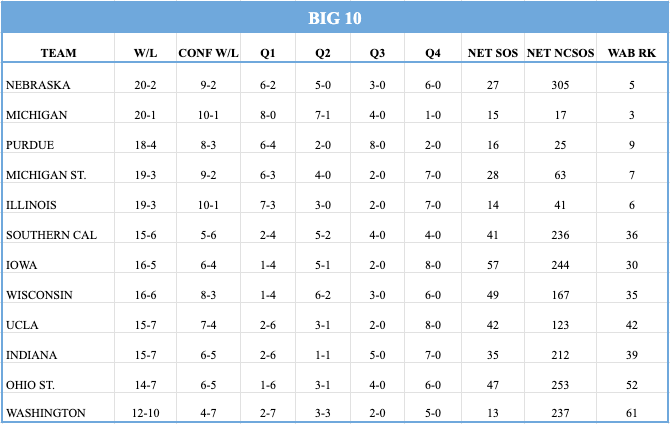
Locks:




On the Right Track:
Purdue (8)

We may have seen a Purdue team bottom out this past week as they lost their 3rd in a row, this time to rival Indiana on the road. It felt like the sky was falling if you were plugged into the Boilermaker fanbase, but the Boilers bounced back by dropping the hammer on Maryland in a 30 point rout to settle everyone down. The biggest takeaway from the big win was seeing Fletcher Loyer return to form, as the sharpshooter had been receiving most of the heat during the rough stretch as he went 4-17 from 3. On Sunday he knocked down 7 threes on 10 attempts, and if that is him breaking out of his slump then we may really have this team back to it’s top form. From a resumé perspective it’s important to point out that every game matters equally, so while the 3 in a row seemed bleak, overall they are still entering the week 6-4 in Q1 which has them still solidly on the 3 line right now. They have a long break as they don’t play again until Saturday, with another easy one on deck with a wounded Oregon coming to West Lafayette. Ideally, we’re coming to you next week with Purdue still sitting at 8-4 in Q1/2 and staring down the barrel of road trips to Iowa and Nebraska. That’s where we’re going to find out how they’ve truly bounced back from the low point.
Iowa (20)
The Hawkeyes continued to roll this week as they pulled off a wild victory over USC in the dying moments at home and then went to Eugene and smacked around Oregon. They have perfectly embodied new HC Ben McCollum’s style as they play at a snails pace and just try to out execute you in the halfcourt. That style is working, and with Bennett Stirtz leading the way they are in pretty good shape to make the tourney in year 1. The only thing they’re missing right now to feel extra secure are the Q1 wins, as they just have the 1 @ Indiana to their name. Overall they are 6-5 in Q1/2 but to truly feel safe come Selection Sunday they are going to want to beef that Q1 win total up no doubt. This week presents a giant opportunity as they head to a feisty Washington team, looking for a big time win in their own right, so finding a way to win that would go a long way. A loss would push them closer to the cut line, despite being 20th in the NET, as they could find themselves in bigger trouble sporting just 1 high quality win. They host Northwestern after that, so 1-1 minimum to keep the Hawkeyes from the true danger zone, but they’re going to have bigger chances down the road, so no need to panic if they do fall in Seattle.
Teetering:
Wisconsin (41)

The Badgers certainly played with their food this week as they had what looked on paper like 2 fairly simple home games but right out the gates they fell down 20 to Minnesota. They battled back and pulled out a victory, riding the backs of John Blackwell and Nick Boyd who both scored over 20. They handled Ohio St a little easier, and it was that same duo carrying the load, but that Minnesota game had to have been a red flag for that locker room as you simply can’t come out that flat in Conference play, they got lucky to squeak that one out. Right now they are still being buoyed by that road win over Michigan, which continues to be the best win on the Watch, but sitting at just 1 Q1 win is going to grow increasingly concerning as other teams start to pass them in that win total. The rest of the resumé is strong, with a 6-1 Q2 record really jumping out, but I’m looking for this group to add a key win or 2 down the stretch before I feel overly confident. This week they have a big test in that regard, as they play just once @ Indiana. The Hoosiers are getting hot, but are still desperate to win games and climb into the field, so that’s a tough one that could drop them to 1-6 in Q1. If that happens, pressure will be mounting as we get deeper into February.
USC (48)

What a wild week for the Trojans as they started off the week with an absolutely bonkers game @ Iowa in which they led at halftime, got down by as much as 17 in the 2nd half, only to roar all the way back to take a late lead with 8 seconds left. They proceeded to lose that one, in spite of the fact Kam Woods had 33 points, more than his 23 total points on the season! Insanely bizarre game that ultimately just stacked up another Q1 loss for the Muss Bus. They returned home and battled a feisty Rutgers team and picked up a win they had to have as they continue to try and steady the ship in Big 10 play. 3 of their 4 Big 10 wins right now are over Minnesota/Maryland/Rutgers, so it hasn’t exactly been a success so far in January, but they’re holding on to some good wins in the non-con to stay afloat. This week is an important week, not because it presents golden opportunities but it gives them 2 games they really should win if they are who they think they are. First they host a white hot Indiana team, and then they go to Penn St. The Hoosiers have won multiple in a row but are playing their 2nd game in LA so I think that favors the Trojans on Tuesday night. Then is the cross-country trip to Penn St, who is a sleeping giant, with emphasis on the sleeping. They have only won 1 Big 10 game, so calling them that seems ridiculous, but they have played Michigan St, Michigan, Purdue, Illinois and Ohio St all to single digit games. They are not a team you want to take lightly, even at 1-10 in league play. An 0-2 week would be catastrophic, and even 1-1 would be disappointing and likely drop them square into the cut line of the bubble.
UCLA (44)
I honestly don’t know what to make of this UCLA team as they seemingly had it rolling as they knocked off Oregon in Eugene to make it 5 wins out of their last 6 games. Then they went back to Westwood and lost a 2 OT thriller to IU. Should we be disappointed? I’m not sure, because that one could have easily gone the other way multiple times and we’d be sitting here talking about the Bruins winning 6 of 7. Clear eyes tell us it’s just a blip, and with Donovan Dent continuing his strong play of late I do think they’ve still rounded that corner and should be a solid tourney team come Selection Sunday. However, they still have work to do, and that loss to IU was a resumé setback as they fell to just 5-7 overall in Q1/2 with just 2 Q2 wins. Work yet to be done to say the least and they head into this week with 2 very winnable home games on deck. Only one of them will carry much weight as they host Rutgers first but the matchup with Washington is a chance to improve the Q2 record. Ultimately, every win counts right now, as even a Q3/4 win is at least avoiding adding a black stain to the resumé.
Indiana (30)

As much as I hate to type this, noo team on the Watch had a better week than the Indiana Hoosiers. They first knocked off Purdue at home to notch an all-important Q1 win and then flew out to LA and followed that up with a Q1 win @ UCLA in 2 OT. The story of the improved play has to begin and end with the emergence of Nick Dorn, who has been on fire from beyond the arc making 16 three balls during this 3 game winning streak. That has catapulted them into as high as the First Four in Dayton as they now sit 3-7 in Q1/2 after barely being in the discussion at just 1-7 last week. The home win over Purdue gives them the signature Q1(A) win we’re always looking for as well, so that is going to set them apart from some of the other close bubble teams they’re jockeying for position with. They stay out in LA to begin the week as they play USC, another Q1 chance and then come home to face Wisconsin. The game against the Badgers is very important because that Q2 record sitting at just 1-1 is a real weak point. Picking up that win, even if they lose to the Trojans, will be huge as they try and salvage their at-large hopes. Obviously, staying hot and going 2-0 would do wonders, but realistically splitting that trip to LA is a huge win and then holding serve at home keeps this thing heading in the right direction.
Ohio St (40)

Ohio St didn’t really do anything to alter their position on the bubble this past week as they took care of business against Penn St at home and then lost to Wisconsin in Madison. That loss was the epitome of their season as they continue to not be able to get stops against high level competition, as they now sit 77th in Def efficiency and 199th in 2-point FG% allowed. So, if anything, their case got a little weaker as they fell to 1-6 in Q1 and just 4-7 in Q1/2 overall. They are probably being better received than they should be at this point because right now the resumé is a lot closer to that of a mid-major than a power conference team when you’re looking at the top wins. They have a road win over Northwestern who is barely clinging to top-75 and then just one top-50 win at home vs UCLA. That is very weak, so there is mounting pressure on the Buckeyes to find a big time win to bring to the table on Selection Sunday. This week they go to Maryland, one you have to win and won’t do much but stain your resumé if you lose, and then they host rival Michigan. That’s one you have to have circled as they played the Wolverines close in Ann Arbor so adding an elite win like that is exactly what they need. A loss leaves us in the exact same situation.
Outside Looking In:
Washington (47)
The Huskies are the first new addition to the Watch this week as I dug a bit more into their current resumé and their remaining schedule and a glimmer of hope was spotted. Right now they are decently far out of the conversation at just 12-10, but the win @ Northwestern this weekend gave them a fighting chance as they moved to 5-10 in Q1/2. They have very strong SOS numbers and frankly when you look outside of Q1(A) they’re 12-4, which should be a woah moment. We’re comparing them to teams who haven’t even played a Q1(A) game much less won one, so going 0-6 there shouldn’t be a disqualifier. What they have in front of them is the chance to rip off a lot of wins in a row, as the final 7 games are all very winnable, with only 3 road trips to Rutgers, Maryland and Oregon to come. They would get Penn St/Minnesota at home, there’s 5 wins getting them to 17 total, and then host Wisconsin and USC to push them to 19 potentially, adding 2 more Q2 wins. For those savvy fans out there, I’m intentionally leaving out 2 games, as there are 9 to play. Those are both this week. My path to a Washington Huskies at-large ticket getting punched has have a 1-1 split this week I believe, as they host Iowa and then go to UCLA. I think they need to get a 3rd Q1 win to have a chance, and these are there final 2 before a potential opportunity in the Big 10 tourney. So, to recap, they need to go 8-1 over their final 9 games, and while that sounds like a tall mountain to clime, 5 of those are against the bottom-6 teams in the conference. Season comes down to winning 3 out of 4 vs Iowa/USC/UCLA/Wisconsin, 3 of which are in your home building. It’s a daunting task sure, but Danny Sprinkle if you’re reading this I see the path my friend. It all hinges on this week though, gotta find a way to win a ballgame.
–Big 12–
Locks:



On the Right Track:
Kansas (14)

While the answer to our all important Darryn Peterson question was not really answered on Saturday, his return for the 1st half against BYU exemplified why it’s so important. He was absurdly good, and helped the Jayhawks build a 20 point halftime lead. They unfortunately blew that lead after he was forced to exit once again with “cramps” in his legs early in the 2nd half. In the end, they were able to hold on and get a huge W over the Cougars at home, but it is clear how high their ceiling can be if this kid can find a way through whatever it is that’s preventing him from playing a full game. They have a quick turnaround with another monster matchup as they head to Lubbock to face a Tech team coming off a loss tonight. That’s followed by an easy one at home vs Utah, so 1-1 on the week should be the bare minimum, with a chance to make a major statement if they can take down the Red Raiders. As of now, they sit pretty firmly on the 4 line as they have 4 Q1 wins and are 11-5 overall in Q1/2. If they can continue to build on their current 5 game winning streak they will keep on flying up the seed list as they continue to emerge as a real threat nationally.
Texas Tech (19)

Texas Tech has a fantastic resumé right now, with 3 elite wins over Duke/Houston/BYU, but they did take a hit when they went to Orlando on Saturday and lost to UCF. The issue in their losses has been defense and that cropped up once again as they let UCF score 88 points on just 69 possessions. That on top of losing the possession battle by 16 and you have a pretty clear picture as to why they lost. Ultimately all that means is they dropped from a potential 3 seed down to the 4 line, but they have an immediate chance to bounce back as they welcome Kansas to their home building. Picking up yet another Q1 win to get them up to 5 total would get us very close to locking this up, especially if they go to Morgantown later in the week and handle West Virginia. A loss in either one of those would keep them below .500 in Q1, and while I can’t really imagine a team with 5 Q1 wins missing out, we’re always one injury or catastrophic collapse from it at least being interesting come Selection Sunday. No matter the stakes, it is going to be must-watch college hoops tonight in Lubbock when the Jayhawks come to town.
BYU (15)

You certainly have to have a few more questions about this BYU team after the last couple of weeks have seen them lost to Texas Tech, Arizona and most recently Kansas. They battle back well against both Arizona and Kansas this week, but ultimately it goes down as an 0-2 week in Q1, as close only counts in horseshoes and hand grenades. The concern you start to have is they haven’t beaten an elite team, going 0-4 against top-30 opponents. They still have the 4 Q1 wins, but right now you could very fairly call them a bit of a paper tiger, even though they have AJ Dybantsa and plenty of talent around him. On paper, they should be able to compete with the top teams in the sport, but we just haven’t seen them put it together for a full 40 minutes and get it done. Lucky for them, they’ll get 2 more chances this week as the gauntlet that is this year’s Big 12 keeps on swinging, as they head to Oklahoma St and then host Houston. A 2-0 week would shut up all the people who may be doubting this group right now, as beating this year’s Houston team is no easy feat, and exactly the type of win they need to cement themselves at the top of the sport.
UCF (37)
The win on Saturday for the Knights has put this UCF team in prime position to get back to the dance for the first time since 2019 as they now have 3 very solid wins, at home vs Kansas/Texas Tech and @ Texas A&M. Two of those are good for Q1(A) status and they have 0 losses outside of Q1 so it’s squeaky clean right now and very solid at the top end. The story here continues to be Themus Fulks who is now on his 4th school in 5 years but having a career year after bouncing around the mid-major ranks. He had 21 points and 7 assists in the win over Tech as he continues to make a surprise case for an All-Conference bid. All of this positivity could come crashing down though as this week presents 2 tough road challenges, as they head to Houston and then Cincy. Now, one of those is not quite like the other, but still Cincy is very good defensively and has won their last 3 home games, including an upset of Iowa St. Lose both of those games and we’re sliding the Knights back to somewhat rocky ground at just 3-6 in Q1, but I still look at the top flight wins and can’t see them dropping too far down the seed list as they are in the 6-7 range right now. A truly unbelievable season thus far, and honestly just finding a way to go 1-1 this week would be enough to keep this thing right on track.
Teetering: N/A
Outside Looking In:
TCU (54)

What a disappointing week for the Horned Frogs as they fought tooth and nail at home to try and steal one from Houston, ultimately coming up short, and then went out to Colorado and got absolutely boat raced. Jamie Dixon has to be upset with the effort on Sunday, as the team that went nose to nose with Houston should not be getting beat by 26 vs Colorado, I don’t care where it’s played. The effort simply wasn’t there, and frankly they were beat from pillar to post and should be embarrassed by that effort. Hopefully that is a moment they can learn from and not let it be the unraveling, and they’re lucky enough to not play again until Saturday when they host K-State. That’s a must-win at this stage, especially after this recent performance you have to do something to get the belief back. They still have those wins over Florida/Wisconsin/Baylor away from home, but they’re also working against a Q3 and 4 loss so it’s going to take more than just 5-7 in Q1/2 to get themselves in position for an at-large. They slid way back this week, but there’s still 9 Big 12 games on the schedule, with plenty of chances to turn this thing around. Just have to get back rolling.
Oklahoma St (67)

Oklahoma St did what they had to do in beating Utah to continue lingering around in the conversation, but without that signature Q1 win (0-4) they are still a decent ways out of this thing. They do have a couple of solid wins over UCF and Texas A&M, but neither of those teams are top-30 and their best win away from home is Grand Canyon, with their best road win being the one they just picked up @ Utah. Not a strong case that they’re making, especially considering the non-con SOS is an abysmal 271st. That all would take a dramatic turn if they could pick off BYU at home this week, or beat Arizona in their building but I don’t think we even need to consider that happening at this point. BYU has to be the target, but unfortunately the Cougars are going to be hungry to get back in the win column after dropping 2 straight to Arizona and Kansas last week. Not a great time to face them, you’d much rather face a Cougar who’s fat and happy than hungry and desperate. Either way, the Pokes should be even more desperate, as falling to 0-5 with a trip to Zona likely sending them to 0-6 in Q1 is just going to see them fade further into the darkness.
Baylor (56)

The Baylor Bears have a pulse! Just as I was about to prepare the casket and inform the families, Baylor went into Morgantown and knocked off West Virginia to add another Q1 victory and end their 4 game losing streak. It’s still only 2 wins in their last 9 games, but if only temporarily, they have slowed the bleeding. Cam Carr and Obi Agbim lead the way offensively, but it was the defensive effort that shocked me the most as they had been dreadful on that end but held WVU to just 53 points. That of course was on the heels of the loss @ Cincy earlier in the week, so in total it was just a 1-1 split on the road, but that’s enough to keep them on the Watch a bit longer as they still do sport a 5-9 record in Q1/2. The SOS numbers are very strong, and the 3 Q1 wins stand out in this bubble environment. Granted, none of them are over top-40 opponents, but we’re not talking about a team that’s in the field, merely just hanging around and needing to go on a run. They have another must-win with Colorado coming to Waco and then they have a near impossible task as they go to Iowa St. We’re just looking for a 1-1 week to stay alive.
West Virginia (66)

The Mountaineers hopes for an at-large are now on life support, and honestly if they weren’t in the Big 12 with all of these opportunities ahead of them, I would have already pulled the plug. What I wanted to see from them this week was to handle their business at home, and they did that early in the week beating K-State. Then they let a reeling Baylor team walk into Morgantown and take their lunch money. Not good enough, and frankly at 2-8 in Q1/2 it’s kind of an abomination they are on the Watch at all, but that is the nature of the bubble this year. It could just be that the win over Kansas was just fool’s gold, but when you flash that kind of ability you get a longer leash around here. This week they go to Cincy and then host Texas Tech. You just have to win both right now if you’re the Mountaineers. There are too many teams in the mid-major ranks carrying strong Q2-4 records to stick around the conversation if you’re not cashing in on these opportunities.
–Big East–

Locks:

On the Right Track:
St. John’s (24)

The Johnnies could very well be hitting their stride, as the recent pounding of Butler at home gave them their 7th win in a row. As we discussed last week, it was a rocky road out of the gates but it seems Pitino has his tight 8 man rotation pretty much nailed down as we steamroll into February. Dillon Mitchell has been the story of late, exemplified by his 14 pts, 13 rebs and 4 asts the other night vs Butler. If he is putting up that stat line in the front court next to Zuby Ejiofor all of a sudden this becomes a scary dominant group up front. This week presents the ultimate test in the Big East though as they host UConn. That is the true measuring stick as the Huskies have just 1 loss on the season, to undefeated Arizona, so if St. John’s can knock off Hurley and co. that will be the indicator that they must be taken serious nationally. What they can’t allow to happen is to be looking too far ahead the way I am, as they still have to go to DePaul Tuesday night before the UConn game. St. John’s is on a great track, and a 2-0 week would put them on firm ground for the dance. There’s that chance though they get caught with their pants down and lose to DePaul and then can’t get it done against UConn. Then we’re looking at a trip down to the muddy bubble waters.
Villanova (33)

Unfortunately for Nova weeks like these are actually not great as teams all around them are picking up impactful wins while they simply beat Providence at home to stand pat at just 5-5 in Q1/2. They also have the issue of not having a single win over teams in the top-40 of the NET, so while they have a great record at 16-5 overall, it is somewhat reminiscent of those weak ACC or the MWC resumé’s we’re seeing. It doesn’t get much better this week unfortunately, as they host Seton Hall and then go to Georgetown. Those aren’t easy games by any means, but they are merely Q2 games that at this point they have to have but don’t address the key hole in their resumé. February 21st is going to be the date we have circled for Nova, as if they can avoid the land mines prior to that point then a win in the rematch with UConn would be exactly what the doctor ordered and make me feel very good about their case. There is a lot of work to be done prior to that point, so we’ll look for a 2-0 week that would boost them to 7-5 in Q1/2, keeping the wolves at bay as try and keep that gap between them and the true cut line.
Teetering:
Seton Hall (49)

You have to consider this week for Seton Hall as big as any that they’ve had all season, as they came into the week absolutely reeling after losing 4 in a row. They were able to bounce back with 2 massive wins at home, and while they were merely Q3 wins over bottom dwellers in the conference, it had to be a relief to get back in the W column. 5’10” guard Budd Clark was the story in the 2 wins as he had a combined 43 points, 10 rebounds 10 assists and 6 steals in the 2 games. If they get that level of Adam Clark the rest of the way things will be looking up in Jersey as they are desperate for a consistent scorer to go with their lockdown defense. Now, all of this positivity is about to be put to the test as they hit the road this week, playing Nova and Creighton. Those are not going to be easy, but they really need to find a way to steal one of those to not fall further out of this thing. The trip to Creighton is obviously going to be more attainable, and while it may end up being just a Q2 victory they can’t afford to drop a 4th Q2 game if that’s where Creighton is going to fall. Right now, they’re out, so while it seems like asking a lot the Big East isn’t offering a lot of opportunities, so the Pirates need to start capitalizing before it’s too little too late. After this, it’s really only St John’s/UConn. Now is the time to strike.
Outside Looking In:
Butler (64)

Well, if last week Butler’s at-large hopes were hanging on to the edge of a cliff, they just lost their grip with one hand and are down to one singular hand holding on for dear life. That is thanks to a home loss to Georgetown which saw them miss their final 14 shots from the field. That took their ugly 4-8 Q1/2 record and added a Q3 loss to the mix. I know that this thing is bleak and they are probably the farthest team out of it on the watch, but my hometown small college still has a viable path and damnit I’m going to hold on to it. They have 2 must-win road games this week as they head to Providence and Marquette. Those are not easy trips, but if you want to make the tournament those are simply games you have to win. They won’t even add much to the resumé, but quietly they could improve their Q2 record to 4-4 which would bring them one step closer to clawing their way back into the conversation. After that they host UConn and Seton Hall. This is a 4 game stretch where they have to be playing like their lives depend on it, and nothing short of 3-1 will do. If they can manage that, they could jump to 7-9 in Q1/2 with 5 games to play. That’s the short terms path to staying alive right now. Do I have confidence? How could you after the loss to G’Town, but I have hope and that’s what we’re here to provide in bunches.
–SEC–
Locks: N/A
On the Right Track:
Vanderbilt (13)

For those that had major questions about this Vandy team I think you can go ahead and take a seat and consider them answered after they completely undressed Kentucky in Nashville. That 25 point drubbing was about all I needed to see to say, okay, I think they’re going to be just fine. They did it without Duke Miles as well, with Tyler Tanner continuing to shine as he took on more of the load in the back court as he had 19 against UK and then 24 later in the week in their win over Ole Miss. That’s now 3 W’s in a row after that little slip in January that saw them lose 3 straight, so a very nice bounce back and what looks to be a rock solid resumé forming. They still have just 5 Q1 wins, only one of which is Q1(A) and only 2 of those being top-30 opponents though, so a collapse would still make this interesting. I don’t think it’s going to happen, but again I’m trying to keep all scenarios alive, not just the one’s I believe to be likely. This week may be enough to move them to locking as they just host Oklahoma. The Sooners play everyone tough and then lose late, so as long as the Dores at least continue that trend we’ll see them move to an impressive 12-3 in Q1/2. Certainly enough to lock with 20 wins, even with a tough homestretch still to come. A loss brings back the doubters, but that would be the most insane results of the season, so I’m not betting on it.
Florida (12)
Last week I was pretty cloudy when it came to my opinion on the Gators, as they were on such a roll prior to losing at home to Auburn. That one stopped me in my tracks, a proverbial wrench in the bike tire. However, this week was a clarifying showing as they went to S. Carolina and won by a staggering 47 points and then returned home to blowout Bama by 23. Quite the response, and it has sent them surging up to 7th in Kenpom. They are now 7-1 in their last 8 games, with the computers looking at them as the best team in the SEC right now. All of that said they are still only around the 4-5 seed range when it comes to a resumé so they either are going to be a nightmare for a 1 seed to see in their region or maybe they’ll climb up if they continue to dominate SEC teams. They will get a chance to improve on their 4-6 Q1 record this week as they head to Texas A&M, who is shockingly pacing the SEC right now at 7-1. A monster showdown in College Station as 1st and 2nd place in the league go toe-to-toe with 1st place on the line.
Arkansas (23)
I was really starting to buy in on this young Arkansas team, especially after they went to Oklahoma in a trap spot leading up to the Kentucky game and pulled off a big win. That showed a maturity not often seen in college, but they then turned around and lost their composure in the UK game and showed that youth as they fell to Kentucky in a contentious and sloppy game in Fayetteville. That loss dropped them down to 4-6 in Q1 right as they started surging up the seed list, and they now sit somewhere around the 5 seed line. They still have a ton of promise, but their lack of ability on defense was exposed again in that UK game and it’s just too much for their young FR guard duo to overcome at times. They have a nice break before they head to the punching bag of the conference in Mississippi St, so that break mixed with an easier game represents a good opportunity to settle back down and bounce back. In due time it certainly feels like we’ll be able to lock these Razorbacks in, but for now we will want to see that 7-6 overall record in Q1/2 climb up as it really is being carried by the 2 Q1(A) wins over Vandy/Texas Tech.
Alabama (22)
Alabama is taking on water right now as Nate Oats seems to be losing control of this thing. Maybe I’m being a bit hyperbolic, as they did beat the brakes off of Mizzou earlier in the week, but I can’t seem to shake that blowout loss at the hands of Florida Sunday. That was an ugly loss that you just aren’t used to seeing an Alabama team take under Oats. They almost always can go blow for blow with teams, even if that means losing 95-90 they are always still in the game. Losing 100-77 is not the norm, so while they’re still in a fine position in terms of getting into the dance at 9-7 in Q1/2, it’s only sitting at 3-6 in Q1. In other years that could be cause for concern, but in a year like this where those last 8-10 teams getting in aren’t anywhere close to the wins of the Tide I’m not worried about them getting in. My doubt is about what they do once they’re there, but that’s for another series on this site, here we’re talking resumé and they do have wins over Illinois/St. John’s away from home and UK at home. Those will continue to buoy them even if they keep dropping Q1 games, but eventually if they fall to like 3-11 what does that look like? I don’t think it’ll get that bad, but they have lost 3 straight Q1 games with another Q2 loss sprinkled in there. Needless to say, they need to turn it around, and they’ll have chances to do so this week as they host A&M and then go to rival Auburn. 2 more losses and we may have to hit the panic button on the Tide.
Tennessee (21)

Uh ohhhhh has Rick Barnes finally gotten this team clicking as we steamroll into February? My eyes tell me they’ve turned a corner recently as they have picked up 3 straight wins, all of which are Q1 right now. This week it was a trip to Georgia that they pulled out an OT W after trailing by 6 at halftime and then they came home to beat Auburn. Freshmen sensation Nate Ament seems to be hitting his stride as he has averaged 23 ppg during this little streak. While they still aren’t the same scary team defensively we’ve seen under Barnes, they’re capable and tough on the glass as always, ranking #1 in offensive rebound rate. That’s been the formula, get enough stops and be absolute terrors on the glass, so even when shots aren’t falling they’re getting 2nd and 3rd chances. In terms of resumé they have jumped up to 5-6 in Q1 after being just 2-6 a couple of weeks ago, quite the rise and quite the jump from fringe bubble team to solidly in the field right now. This week they should stay hot in the short term as they host Ole Miss but then they head to rival Kentucky. They let the Wildcats come to Knoxville and steal one, so you know revenge is on their mind, making that one must-watch on Saturday.
Kentucky (28)
This has to be one of the more trying seasons on the collective heart of BBN in a long time, as this team will have lows that drop you to the depths of the Earth, only to bounce back and deliver the highest of highs a regular season game can offer. What I’m talking about is UK going into Fayetteville and knocking off former HC John Calipari in his new home. Whether or not UK fans are happy with him, they certainly all would admit that win fired them up. Not only that, the timing of it being on the heels of another embarrassing effort @ Vandy had to bring back some hope for the season. It was looking gloomy once again after that 25 point drubbing in Nashville, at the hands of Vandy no less, so I’m here to acknowledge the roller coaster BBN is on right now and offer absolutely zero sympathy, you have had your fun, welcome to normalcy. Back to the macro point though here as the resumé got far better with that win bringing them to 5-6 in Q1. They still have that pedestrian 1-1 record sitting in Q2, but if they can pile up a few more wins over there those 3 Q1(A) wins inside Q1 are going to be perfectly enough to make this conversation more about how high they can go vs if they get in. This week they host Oklahoma and then Tennessee, the latter of which will have the nation’s attention as the Vols look for revenge. The Cats have to at bare minimum beat the Sooners at home, but you know they want that season sweep of the Vols. Pick that up, and we’ll be racing to lock territory after having major question marks about UK just a few weeks ago.
Auburn (29)
Auburn has played the toughest schedule in the country so far according to the NET, so we have to keep that in mind as we’re looking at a team sitting on 8 losses right now. Yes, that is much higher than some of the teams I have teetering, but they’ve played 8 Q1(A) games for crying out loud, we have to credit them for winning 2 of those at least. You take out that 2-6 record in Q1(A) and you’re looking at a 12-2 team outside of that. There are teams who have played 0 or 1 or 2 of those games total and hardly have 2 wins there. That is why Auburn is safe, and why we won’t be getting negative around here after they dropped on in Knoxville this week. Tough place to play and a really good team, and it came on the heels of a nice home win over a desperate Texas team so they’re still rolling as far as I’m concerned. They have a nice break and then they host in-state rival Bama who is licking their wounds after a beat down @ Florida. Bama gets a chance to get right prior, but still this is a massive chance to knock off your rival and swing positioning with them potentially as they would rise to 5-7 in Q1 alone. They’re in the midst of a brutal stretch, with 3 more Q1 games coming make it 6 out of 7 in that category. Make it out alive and it eases up with some of the bottom dwellers in this conference.
Teetering:
Texas A&M (35)
The Aggies continued their winning ways this week as they went to Georgia and won comfortably to move to 7-1 now in conference play. They are now in a similar category as Clemson as they quietly are sitting in a power conference with just 1 loss, and crazily are still in the teetering category. Allow me to explain. While they do have 7 SEC wins, they had little to no meat on the non-conference bone, as their best win was a Q2 road win over Pitt (114th). So, they were starting way behind the 8 ball, and in total have only added 3 Q1 wins during this run in the SEC. Play time is over though as this week begins the ramp up in competition as they first head to Alabama and then host a hot Florida team. Those are both Q1(A) games right now so finding a way to even split those games is going to be both challenging and honestly paramount to avoid slipping down into more perilous territory. Teams have gotten hammered over the past few years for playing weak non-con schedules, especially those in the bottom half of the seed list, so the Aggies don’t want to be anywhere close to the cut line as that could be a hit that sinks them. I don’t see them there currently, but they have some tough tests the rest of the way. Have to capitalize on 1 or 2 more chances to really feel safe.
Georgia (36)

The Dawgs are starting to lose their grip on this thing as they have now lost 3 in a row to fall down the seed list into real dangerous territory. The OT loss to Tennessee is going to haunt them as they had chances to win it and just couldn’t get it done. That disappointment and fatigue may have carried over into their next one as they lost another home tilt vs A&M to fall to 3-4 in Q1. They do have the benefit of being 7-4 overall in Q1/2 which is a pretty strong record, it’s just at the top end they’re lacking that elite Q1(A) win and they also have that Q3 loss at home to Ole Miss hanging out there. In all 5 losses they’ve given up over 85 points, so that’s clearly a weak point, and while they play one of the fastest tempos in the Country 60th in Def efficiency is clearly a weak point. That will have to be the focus, but overall they’re still in a decent position to get into the field again, it’s just going to have to include more tough wins as the SEC is brutal once again this year. They only play once this week but it’s another Q1 chance as they head to LSU. The Tigers are down pretty bad at just 2-7 in SEC play, so that is one you absolutely have to have or else that would be 4 losses in a row and a potential free fall diagnosis will be in order. Stop the bleeding and keep it moving.
Texas (39)

The Longhorns stay alive as they were able to go to Norman in part 1 of the Red River Shootout and got a big Q2 win after falling @ Auburn earlier in the week. Dailyn Swain continues to be a revelation as he put up 18/10/6 in the win over the Sooners, helping the Longhorns keep pace with the other bubble teams, and even pass a few who didn’t capitalize. We’re going to quickly turn our eyes forward for this group as the upcoming stretch feels as important as it is unremarkable. They host S. Carolina and Ole Miss this week, 2 games I’m calling can’t lose as they both won’t even qualify as Q2. They can’t afford to take on water at this point with Q3 losses. They then go to Mizzou who is very beatable and then host LSU. This next 4 game stretch at minimum has to be a 3-1 stretch Texas to keep try and fight there way onto the right side of things. As of writing this, they’re the first team out per Bracket Matrix. I have them in, some don’t. It’s that close right now. Every game is important right now, even if it’s just to avoid a disastrous loss. They end with a brutal 4 of 5 Q1 stretch, so stacking up some wins over the next 2 weeks is as important to this team as any team fighting on the bubble, because if you can’t do it now, are you really going to do it against Arkansas, A&M, Georgia and Florida?
Outside Looking In:
Missouri (70)

Mizzou pretty much did exactly what we thought they would do this week, as they went to Tuscaloosa and got blown out and then came back to Columbia and beat Mississippi St. Didn’t really do much for them as they just dropped another Q1 game and frankly fell a bit further out of it if anything at all. This is a gross resumé to try and place because they have 3 fantastic wins over Florida/UK/Auburn, but that 0-3 record is alarming and has to be a nail in their coffin if the season ended today. We have teams who have fewer big time wins but I would think the committee would look at the overall 3-7 record in Q1/2 and see a very inconsistent team that got hot a couple of times, not really a season worth rewarding right now. The good news is there is time to improve that record, and getting it to at least 2-3 or 3-3 feels necessary to getting fully back into the conversation. A great first step in doing that would be going to S. Carolina and winning. Actually, I’m saying it’s a can’t-lose game for the Tigers as they absolutely can’t afford to drop to 0-4 in Q2. Light the resumé on fire if that happens. You jump to 1-3 there and you have life.
–Mountain West–
Locks: N/A
On the Right Track: N/A
Teetering:
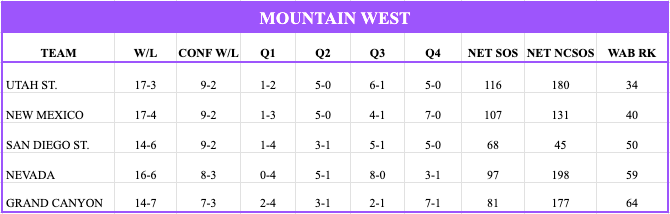
Utah St (26)

Utah St keeps on trending in the right direction as they won a very important matchup against San Diego St on Saturday to tie the Aztecs atop the Mountain West standings. The game was an absolute grind, just the way you’d think it would be against a Brian Dutcher squad. MJ Collins and Mason Falslev couldn’t buy a bucket, but the hero on the day was Karson Templin off the bench who was a major spark with 18 points and 7 boards. That was a game they absolutely had to have as it marks their highest ranked opponent that they’ve beaten. Still not an overly impressive resumé but they won’t apologize for being 17-3 and 6-2 overall in Q1/2. They still have the problem of having no wins in Q1(A) and in fact are one of those teams I’ve referred to previously as they haven’t even played a Q1(A) game much less won one. In my opinion they are walking a fine line right now, as the rest of the power conference teams around them have chances to pick up high quality wins. They can do so much for themselves this week if they can go to New Mexico and pick up a win though. Otherwise they would fall to a measly 1-4 in Q1 with only a couple of chances remaining.
San Diego St (45)

The Aztecs fought valiantly, short handed at that, but couldn’t quite get it done when they visited Utah St on Saturday. At the end of the day they couldn’t quite score enough, and missing Elzie Harrington certainly played a role in that. Whatever the case, it still goes down as a Q1 loss, dropping them to just 1-4 in those games. All of these Mountain West resumés look very similar, with not much meat on the Q1 bone but really strong outside of there, especially in the upper Q2 sections. That’s where this ties in to the opener of this week’s watch as we’re likely staring down the question of the mid-major resumés vs the power conference teams who have a ton of losses but they have those signature wins. It’s a tough question to answer, and one that generally has gone the way of the power conference teams in the past, but this year those teams are especially weak. That gives teams like San Diego St a fighting chance, and they still have 6 more Q1/2 chances to beef this thing up. They have the non-con SOS to help boost them, but there’s no question they need to add more W’s down the stretch. This week is just survive and advance as they host Wyoming and then go to Air Force. No disrespect to the troops, but this should be an easy 2-0 week to set up a string of 6 high leverage games in a row.
New Mexico (42)

New Mexico just got through a ho-hum week with 2 road wins that didn’t do much for the resumé other than to avoid disaster as they beat UNLV and San Jose St. On to the next one as the Lobos look to try and beef up their resumé that looks almost identical to San Diego St with a 6-3 record in Q1/2. They welcome in both Utah St and Boise St this week, with the former being a massive Q1 chance at home based on where the Aggies are in the NET. This is one of those weeks where if you can go 2-0 you really position yourself in such a better spot than if you fail to come away with W’s. They have a chance to jump to 8-3 in Q1/2 which would be really strong, adding a 2nd Q1 win and their first over a top-30 opponent. They have a decent non-con win over Santa Clara as well and they have at least played 1 Q1(A) game with the loss to Nebraska so they didn’t just skirt the non-con entirely. All of that to say this is the biggest week left of the season given the nature of the opportunity that it presents, and the swing it could have with different results. I still have them in the dance right now, but barely, and they’ll continue to lose ground on power conference teams like Indiana, Ohio St and Texas if they start stacking wins. Can’t afford to drop Q1 chances at home, especially in a mid-major conference.
Outside Looking In:
Nevada (59)
Let’s all welcome the Wolfpack to the Watch as they weren’t included last week but find themselves the beneficiary of several power conference teams failing to do anything at all. This group is lead by a big 3 with backcourt mates Tayshawn Comer and Corey Camper leading them in scoring and Elijah Price holding things down in the front court. All 3 are transfers in their first year here so credit to Steve Alford for rebuilding this roster and getting to the point they could be in the bubble conversation after losing most of last year’s roster. I’ll be frank to this point the resumé is not worthy of an at-large berth, but they’re 5-1 in Q2 and have just the one bad loss outside of that, so while 0-4 in Q1 is ugly in this bubble environment one big win can put them right in the mix. They have that opportunity this week as they head to Boise St to try and get that elusive Q1 win. They’ve already gone 0-3 against the top-3 in the conference, so they desperately need to cash in on this opportunity if they want to stick around the conversation much longer. I had to include them though because a win in that game really does bring them close to these other MWC resumés, so they certainly have a path. Especially with Utah St and New Mexico still visiting Reno later in February. It all starts this week though, gotta get a big W.
Grand Canyon (68)

Grand Canyon presents us with a little bit more of a unique situation resumé wise as they have multiple Q1 wins they just are battling a couple of bad losses out there as well. Bryce Drew has gotten his team to play better and better as the season has wore on, overcoming that early season loss to Youngstown St to now have picked up wins over Utah St, San Diego St and Boise the last couple of weeks to surge into this conversation. They are led by Jaden Henley on offense, but their top-20 ranking defensively is the real story as they average nearly 4 blocks per game and are strong on the glass thanks to a very big front line. Overall they are 5-5 in Q1/2 with wins over Utah St and Boise representing their 2 Q1 wins, but they also have the win over San Diego St to give them 2 top-50 wins. It’s not a ton to work with but I think it’s enough if they are able to go on a run to end the season. They almost stole one this past week @ Nevada, but fell in OT, so they’re right there knocking at the door. They still host New Mexico and then go to San Diego St and Utah St down the stretch, so there will be chances to build this resumé up a bit. This week they just have to hold serve as they host Air Force (respect the troops) and then go to UNLV. Has to be a 2-0 week to set up a massive game vs New Mexico next week.
–WCC–
Locks:

On the Right Track: N/A
Teetering:
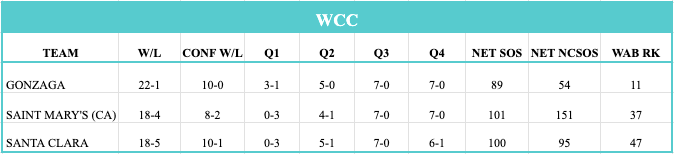
Saint Mary’s (32)

The Gaels were unable to go into Spokane and knock off Gonzaga, and while that is a tall feat, the loss dropped them to 0-3 in Q1. While I along with everyone else still have them in the field right now, I have them just barely in as I’m not sure how this resumé can be put over some of the teams other people in this world are. Their best win right now is over 55th ranked Virginia Tech. I would argue almost all of the above Mountain West teams have a better resumé right now than the Gaels, as even they lost @ Boise St, so I’m not sure how people think they’re on the 9-10 seed line right now other than just looking at NET ranking. The committee has repeatedly said if all you have is your NET ranking then you don’t have much, and that’s where St. Mary’s is and is going to be until the last week of February. The only Q2 chance they even have is @ Pacific, but that’s honestly not going to add much. Then the last week of the season presents them home games vs Santa Clara and then Gonzaga. I think they very well may have to go 2-0 that week to have high hopes of an at-large berth. If they enter Selection Sunday at 0-4 in Q1 with their best win being, even Santa Clara I don’t know if you can make a case the Gaels would have had a season worthy of going dancing. The pressure is on, albeit in the distant future, but they certainly can’t afford to drop any of the gimme’s on the schedule in the short term.
Santa Clara (43)

Santa Clara just keeps on humming along as they have now won 6 in a row since the loss @ Gonzaga, doing exactly what they need to do to stay in the conversation. This week they at least get a Q2 chance that will be very important not to drop as they go to Pacific. Lifting that record up to 6-1 will only help their cause, and then they go to Wazzu in a Q3 game that they also can’t afford to drop. It’s all about staying focused and surviving right now for the Broncos, as they lie in wait of their big opportunity to come the following week with the Zags coming to town. It really does just all come down to that game, as winning that would put them in prime position to get in with a monster Q1(A) win to hold over the rest of these bubble teams. A loss though, and they’ll be forced to try and win @ St. Mary’s after that to try and pick up a signature win to bring to the table. We’re simply in a wait and see mode, that quickly could take a hit if they drop one they shouldn’t. A treacherous world to live in, but when you are trying to make the dance for the first time in 30 years you have to at least be relishing even being in this position.
–A-10–
Locks: N/A
On the Right Track: N/A
Teetering:
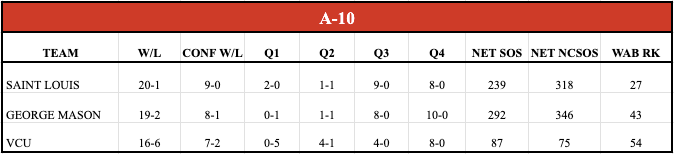
St. Louis (16)

St. Louis was backed into a corner this week as they got down as much as 15 to George Washington at home. Robbie Avila and Trey Green combined for 45 points in the comeback effort that saw them pull a rabbit out of their hat as they outscored the Patriots 24-13 in the final 10 minutes to grab a 3 point W. They followed that up with a 31 point drubbing of Dayton to keep this train rolling as they look poised to go undefeated in the A-10 if they keep up this level of play. I’m going to stay away from how high or low I think they should be seeded and just emphasize they need to avoid adding bad losses to their resumé as they charge forward. They do have the 2-0 Q1 record with wins over Santa Clara and VCU, but neither of those teams are tourney teams right now so I think it could be closer than people realize if they don’t win the A-10 tourney. Nevertheless, there are chances still to add Q1/2 wins that they can’t look past, including this week’s trip to Davidson. Have to just keep on keeping on and we’ll all hope they can cut down the nets in the A-10 tourney so we don’t have to compare them to power conference bubble teams.
Outside Looking in:
VCU (52)

VCU did what they had to do to stay on the fringes of the conversation, as they handled their business at home vs Richmond and Loyola Chi. VCU has a couple of advantages right now in that they played a tougher schedule than most of these mid-major teams and they really don’t have a bad loss. They are just missing that signature win to really vault them into the conversation. They’re 0-5 in Q1 but 16-1 outside of that. Pretty strong, but the only real opportunity they have left prior to the conference tourney is a road trip to St. Louis. That would be a monster win that certainly would catapult them into the same discussions as the Mountain West and WCC teams. I don’t know if they have the goods to go there and upset the Billikens, but that’s the path right now, along with handling their business they way they have consistently done this year against inferior opponents. You could argue their resumé is akin to St. Mary’s right now, with the best win being VA Tech, but they don’t get the luxury of playing Gonzaga at home like the Gaels do. So, we have that Feb 20th date circled and will just hope they don’t step on any land mines between now and then.
George Mason (65)

The Patriots continue to win games they are supposed to as they continue to build that shiny overall record that is now up to 19-2 overall. Their issue is they’ve essentially played nobody as they have just a 1-2 record in Q1/2, so of all the mid-major teams on here they are the furthest away from the actual at-large conversation. What we’re looking at in terms of a path for them continues to be the final week of the season when they go to VCU and then host St. Louis. I would think they’d need both of those wins to surge into this thing with some legitimacy. They will get G. Washington on the road before then as well, so jumping to 4-2 in Q1/2 would give them a real shot if they were to fall in the A-10 tourney. 3-3 may have them in the conversation, but I would see that being a GM logo on the First 4 Out or Next 4 Out graphic on Selection Sunday. The margins are thin, but when you play absolutely zero impact competition in the non-con slate this is what you do to yourself if you want to make a run at an at-large bid. They get Duquesne and St. Joe’s this week, a must go 2-0 week yet again as they lie in wait for their opportunity to strike down the road.
–Others–
Locks: N/A
On the Right Track: N/A
Teetering:

Miami (OH) (53)

The emerging story of college basketball are your Miami RedHawks who have, seemingly out of nowhere, gotten off to a 22-0 start to this season. They are a very balanced group with 5 guys averaging double figures so credit to HC Travis Steele who has recruited and developed many of these guys, with only a couple of transfers who also were here last season. It’s a great mid-major story, and nice to see considering how top heavy the sport is feeling in the portal/NIL era. Now, I hate to take the air out of the balloon, but I’m sure you’re aware at this point the schedule is Charmin soft, which unfortunately is very bad news when it comes to evaluating them for an at-large spot. I have already heard the discussions beginning to take place about what would happen if they run the table and then lose in the MAC tourney. Similar to St. Louis, I have very little hope that the committee would give an at-large spot to a team without a top-50 win. They would have benefitted greatly from a trip to Akron, but unfortunately their only matchup with them was at home and is just a Q2 win. It would be an unprecedented resumé I will admit, but it is likely they would be stacked up next to high major teams who would likely have several top-50 wins. The only way I see it happening is if it’s a close loss to Akron, and even then they need the other bubble resumé’s to be weak. We’ll of course be tracking this week by week, but I know I’ll be rooting hard for the Miami (OH) at-large conversation to be moot come Selection Sunday.


















 5-STAR Bracketology